The Fae
Fae is an umbrella term used to describe a vast family of magical beings whose origins lie in the supernatural realms commonly referred to as Faerie, the Otherworld, the Feywild, or the Realm of the Fae. There is no single appearance, culture, or nature that defines all fae. Rather, the term encompasses countless races, species, bloodlines, and supernatural peoples.
Fae are an entire supernatural kingdom of related but extraordinarily diverse peoples, rather than simply another humanoid race. Different fae can have radically different appearances, cultures, abilities, and relationships with the mortal world. Not every species will look alike or even behave alike. Fae can range from beautiful supernatural aristocrats to tiny house spirits, dangerous water horses, tree spirits, shapeshifting tricksters, monstrous trolls, death omens, and elemental beings.
Many have for centuries lived openly among mortals but still remained the stuff of folktales and stories rather than widespread accepted fact, although since 1960 they have maintained high visibility and integration into human society while still being ruled by their own hierarchy of the Seelie and Unseelie courts. In terms of where you can find them in Gravesbury, various species have been known to inhabit the forests, enchanted lakes, the ocean depths, abandoned ruins, or even the spaces beneath bridges and within people's homes.
Among the many peoples classified as fae are Sidhe, elves, merfolk, brownies, pookas, pixies, fauns, trolls, goblins, dryads, nymphs, selkies, kelpies, leprechauns, banshees and countless other beings.
Because of this immense diversity, fae are often classified according to their elemental affinity, natural environment, physical nature, or traditional habitat rather than by species alone.
The Fae Are Not One People
Ultimately, “Fae” describes a supernatural classification rather than a single race.
A mermaid, an elf, a brownie, a troll, a pixie, and a noble Sidhe might have almost nothing physically or culturally in common, yet all can legitimately be considered fae because they share a connection to the fae realm and the supernatural forces associated with Faerie.
All types and species of fae can be either Seelie or Unseelie in nature. This does not necessarily mean “Good” and “Evil” as there are many grey areas existing in between. Similarly, because a fae is Unseelie or Seelie does not necessarily dictate what their behavior and actions will be, as each fae is unique individual, much like with humans, witches, shifters, vampires, ghosts and aliens.
Sidhe aka The Noble Fae
Separate from environmental classifications is the concept of social and political status.
The Sidhe are considered one of the most prominent noble fae peoples. Rather than being simply "forest faeries," the Sidhe may constitute ancient aristocratic fae bloodlines whose members can belong to the two different courts and possess a variety of elemental or environmental affinities.
The noble fae might include:
These beings rule territories containing many different fae species rather than being rulers of only their own species.
The Sidhe are:
• Extremely beautiful
• Tall and graceful
• Long-lived or immortal
• Supernaturally intelligent
• Powerful in magic
• Proud and aristocratic
• Closely connected to nature
• Bound by ancient laws and traditions
• Capable of powerful glamour
• Potentially dangerous despite their beauty
Sidhe can either be utterly fascinated by mortals/humans and other supernatural races or disdainful of them, looking down upon them as they feel they are a superior, higher race. Usually the Seelie are the ones fascinated and drawn to humans, whereas the Unseelie can be as well but usually they want them for darker reasons, whether to enslave them in servitude to them, or consume them as food. Some Unseelie Sidhe genuinely get along well with humans and other supernatural races however, as for the Seelie Sidhe; there are always exceptions to what is usually seen or known.
Overall, Sidhe tend to represent the more powerful end of the fae spectrum.
Pixies
Tradition:Southwestern England, particularly Devon and Cornwall
Pixies are small fairy beings traditionally associated with ancient sites, hills, woods, and the countryside. They are generally mischievous rather than outright evil and are notorious for confusing travelers, playing tricks, dancing, and creating disturbances. When you think the traditional image of a tiny winged fairy that is what a pixie generally looks like.
Boggarts / Bogies
Boggarts are troublesome household or wilderness spirits related to the broader family of hobgoblin-like beings. A household boggart might cause things to disappear, make noises, disturb animals, or play unpleasant tricks. Some stories portray them as malicious, while others make them troublesome rather than truly evil.
Attempting to escape a boggart may not work, because the creature sometimes follows the household to its new home.
Brownies
Brownies are household faeries who traditionally emerge at night after the humans have gone to sleep. They perform chores, clean houses, tend animals, and sometimes help with farm work. In return, people might leave them milk, cream, or food.
But brownies can be easily offended. Offering them clothing or treating them as servants may cause them to abandon the household, while insults or exploitation can cause them to become mischievous or troublesome.
Goblins
Goblins are generally grotesque, mischievous, and frequently malevolent supernatural beings that are short in stature (ranging from around 3 ft up to 4’8 tall). Some are household spirits, others inhabit caves or underground places, while some behave more like malicious wilderness spirits.
Unlike the tidy green-skinned fantasy goblin of modern fiction, goblins come in a much wider range of appearances and behaviors. Some are not even that unpleasant looking, but most like to use Glamour on themselves to make them appear more conventionally attractive.
Redcaps
Redcaps are among the more sinister goblin-like faeries. They are murderous beings, and folklore associates their name with the blood that stains their caps. Unlike brownies or benevolent household faeries, the redcap is distinctly dangerous.
Merfolk
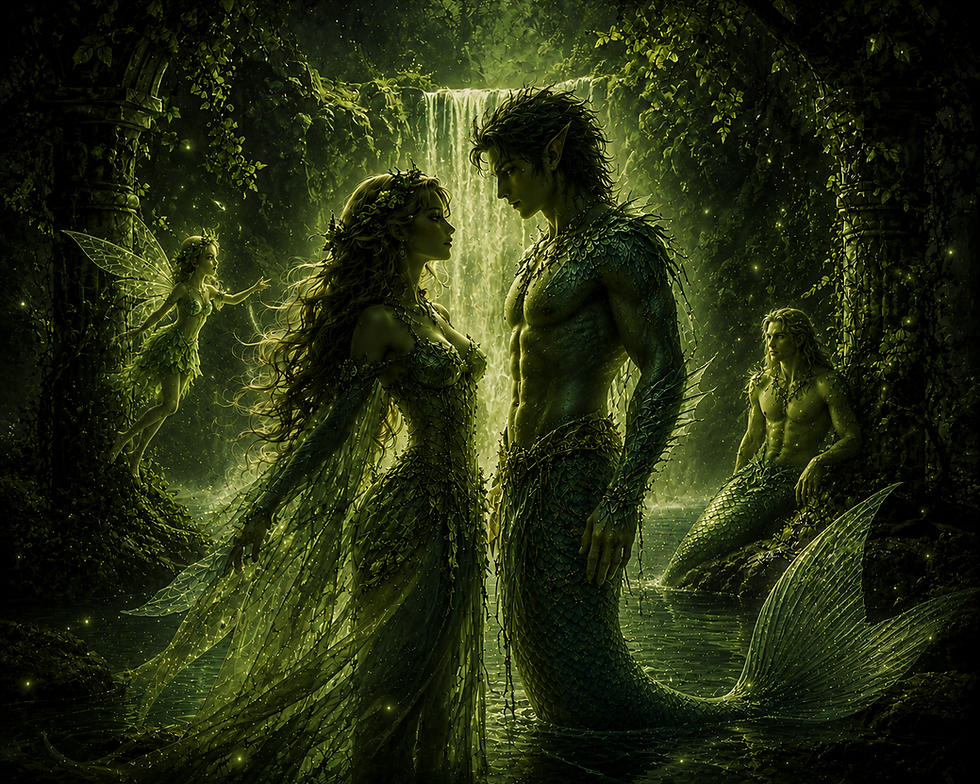
Mermaids and mermen dwell in oceans, under the waters and can breathe underwater like fish. Their lower torso are fish tails, while their upper torso appears humanoid. Their tails can come in a large variety of patterns and styles, and they are usually very beautiful or handsome beings, and have hauntingly beautiful songs they sing, with voices that are unlike any human. When one single mermaid or merman sings, it sounds like a whole chorus of voices singing in harmony. They are generally benevolent fae but some can be dark and malevolent, depending on if they are Seelie or Unseelie. The Unseelie merfolk are much like Sirens in they will often lure humans with their voices and then drown them or eat them if they take their hands. Both Unseelie and Seelie merfolk can have a tendency to play pranks on sea-faring humans or those who are swimming in the waters recreationally, pranks which range from relatively harmless to downright malicious and dangerous.
Kelpies
The kelpie is a supernatural shapeshifter fae. It commonly appears as a beautiful horse, often inviting travelers to climb onto its back. The deception is deadly: once someone mounts the kelpie, they may find themselves unable to dismount, after which the creature drags them into the water. Kelpies can also take human form.
Selkies
Selkies are seal-like beings capable of removing their seal skins and becoming humanoid. Many selkie stories revolve around the tension between their human and marine lives. A human may steal a selkie's skin and thereby prevent the creature from returning to the sea. Stories frequently involve romance, captivity, longing, and eventual return to the ocean. See the Irish films “The Secret of Roan Inish” and “Song of the Sea” (animated) for good representations of the selkies.
Sirens
Sirens are traditionally depicted as beautiful supernatural women or men whose voices possess an unnatural, enchanting quality. In the earliest Greek accounts, Sirens were actually bird-women, often portrayed with the bodies or wings of birds and the faces of women. Their later depiction as beautiful fish-tailed women became intertwined with the broader popular image of mermaids. Note: In Gravesbury, the roleplayer can choose whether to portray the siren as half-bird or half-fish. Defined by their voice, Sirens sing or speak in an extraordinarily beautiful and hypnotic manner, compelling those who hear them to approach. Traditional stories tend to portray Sirens as dangerous and predatory supernatural beings.
Naiads/Nixies
Naiads, also known as Nixies, are freshwater nymphs associated with springs, fountains, streams, rivers, and other freshwater sources. They are generally portrayed as beautiful nature spirits connected intimately with the waters they inhabit. Nixies are often portrayed as enchanting and dangerous, using beauty, music, or supernatural allure to lure humans toward the water.
Undines
Undines are water elementals associated with streams, rivers, lakes, and water itself. Like sylphs and salamanders, they can control and manipulate their main element being water.
Nereids
Nereids are sea nymphs. They are generally benevolent or helpful.
They can appear as beautiful young women or men and frequently accompany or assist sea gods and heroes.
Note about Gravesbury: There is an undersea community called Coralhaven along the waters of the beach, where merfolk, undines, kelpies, sirens, nereids, selkies and other oceanic water fae can socialize, play or make their homes.
Dryads
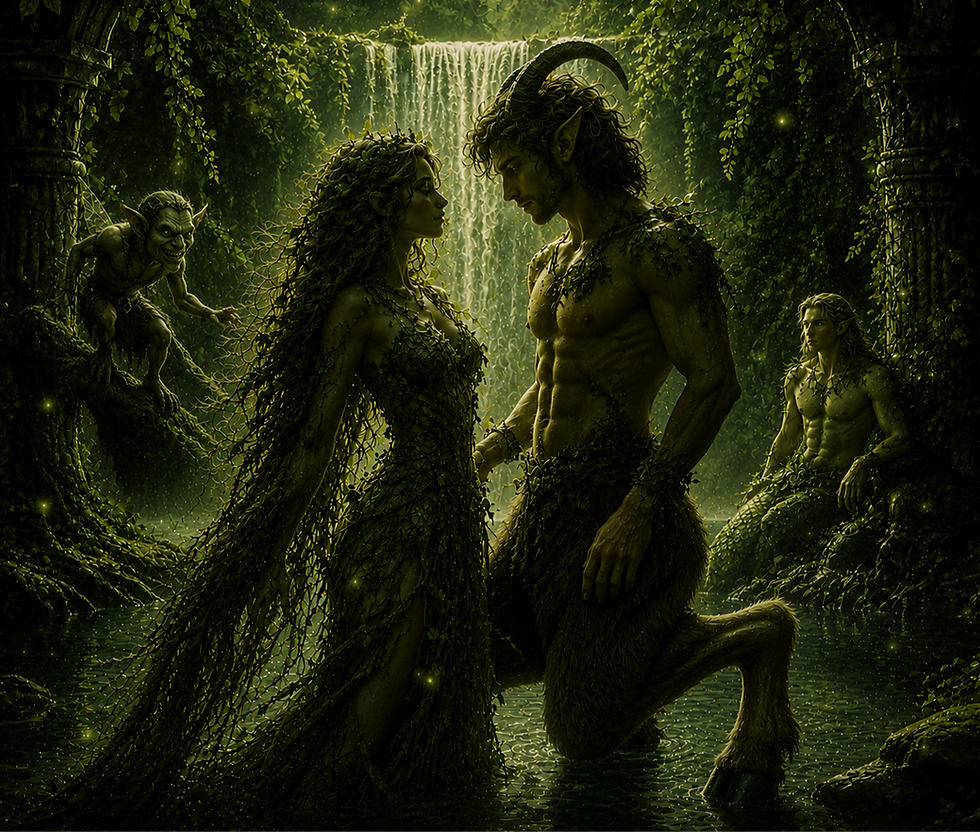
Dryads are tree and woodland fae. They are spirits associated with trees and forests, with some types particularly connected to specific trees. Their existence is intimately tied to nature, and they often resemble trees with branches coming out of their skin and hair that is wrapped in branches and made of leaves. Their skin tones usually are dark brown like the barks of trees, and they are said to be exotically beautiful.
Satyrs/Fauns
Satyrs or fauns are wild male nature beings traditionally associated with forests, mountains, wine, music, dancing, and untamed sexuality. They are typically depicted with goat-like characteristics such as horns, ears, tails, and legs or hooves. They are companions of Dionysus and frequently appear as unruly inhabitants of the wilderness. There cannot be female satyrs or fauns. Fauns usually chase after nymphs of different kinds, both female and male nymphs.
Púca / Pooka
Tradition: Irish
The púca is one of the great shapeshifters of Irish folklore. It can take many forms including humanoid with short pointed ears but is particularly associated with horses and other animals.
Pookas can be frightening, mischievous, or surprisingly helpful. They may lead travelers astray, take them on wild rides, or interfere with human affairs. Unlike a purely evil monster, the púca is better understood as an unpredictable embodiment of the wild and supernatural.
Leprechauns
The leprechaun is a solitary Irish fairy traditionally associated with shoemaking and hidden treasure.
Older folklore presents leprechauns as small, solitary and mischievous beings who may possess or know about hidden wealth. The famous modern image of the cheerful green-clad mascot is a much later development. The reality is that leprechauns can come in a variety of sizes and heights, with some reaching up to 7 feet tall (For a good example, see the character Mad Sweeney in the Neil Gaiman book and streaming series “American Gods”.)
They are notorious for attempting to deceive humans who try to capture them or obtain their treasure.
Hobgoblins
“Hobgoblin” historically refers to a category of supernatural household or countryside beings rather than one precise species. They are typically of normal human height ranging from 4’5 to as tall as 6’4.
Some hobgoblins can be helpful like brownies; others are mischievous or frightening. The term has gradually acquired a more monstrous meaning in modern fantasy. Unlike regular goblins, hobgoblins tend not to be as grotesque or ugly in appearance, they can even be quite attractive by human beauty standards, and their skin tones can range from peachy flesh-toned like humans to black to purple, light blue or pink skinned.
Banshees / Bean Sí
The banshee—Irish bean sí, literally associated with the “woman of the fairy mound”—is a supernatural female figure whose wailing or keening foretells a death.
She may appear as a beautiful woman, an old woman, or a spectral figure with long hair. Some traditions describe her combing her hair while mourning. Her cry is not necessarily what causes death; rather, she acts as a supernatural herald announcing an impending death within a family. Banshees can also be males though this is lesser known.
Elves
Associated with nature, hills, enchantment, sensuality and the Otherworld, elves are universally beautiful, tall, immortal and often archers and/or musicians. Elves are one of the oldest and most prominent races within fae lore. They are a distinct species of fae—magical beings deeply connected to nature, the spirit world, and the hidden realms that exist alongside the mortal world. They are beautiful, long-lived, and powerful beings whose morality and customs are very different from those of humans.
Like most species of fae, Elves possess an innate connection to magic. They are beings who can weave glamour, speak with animals, manipulate the elements, heal wounds, or travel freely between the mortal world and the fae realm.
Dark Elves / Drow
Their exact nature is debated, but they should not automatically be equated with being evil. They can be evil, but many are good-natured and they share in common a propensity for celebrations, parties, live music, drinking and dancing. “Drow”, a dark-skinned elf, is usually grey or silver skinned or black skinned, of human height range from short to extremely tall, and usually with long silver or white hair though Admin Note: How an individual roleplayer decides to depict their drow form and characteristics/personality is entirely up to them. These are merely guidelines based on old folklore.
Trolls
Trolls are supernatural beings associated particularly with mountains, caves, forests, wilderness, and remote places.
Folklore varies dramatically: some trolls are enormous and monstrous, while others can resemble humans. They are often portrayed as dangerous, antisocial, and sometimes vulnerable to sunlight or Christian sacred objects in later Scandinavian tales. They like to hang around under bridges and underpasses and will often tell a human or other supernatural being that they must pay a “toll” to pass through under that bridge. Note: What that “toll” is, is up to the person roleplaying as the troll.
Sylphs
Sylphs are air spirits, particularly associated with the elements and winds. They can stir up winds and control and manipulate the air in many ways, including bringing storms like hurricanes and tornadoes if they are particularly wrathful or angered in some way.
Faerie Hounds and other Fae Animals
A faerie being doesn't necessarily have to possess a humanoid form. There are supernatural hounds associated with the Otherworld, death, hunting, or fairy processions. The Cŵn Annwn are especially famous as supernatural hunting hounds. There also exist in the fae realm supernatural horses, dogs, cattle, birds, cats, and other animals.
There are a great many more species and subspecies of fae out there all over the world, it would be impossible to name them all in one page or even a full site, so we the staff and admins of Gravesbury Park encourage you to do your own research and find out what kind of fae you’d want to play as. You may even make hybrids if you wish, the sky’s the limit and we wish not to limit your creativity with your roleplay and character creation process. These are just some examples and info on some of their characteristics and traits, intended as nothing more than a helpful guide to assist you in your roleplay.